

It's 8:40 PM and Someone's Asking About Your Zapopan Clinic's Hours
By Robert Cushman

Zapopan isn’t a neighborhood: it’s a municipality of more than a million and a half people, with its own downtown, its own basilica and its own medical districts.
And it has an enormous density of practices. Dentists, dermatologists, nutritionists, physical therapists, two- and three-chair dental clinics. Nearly all of them competing for the same patient, in the same area, with the same offer.
In a market like that, what separates one clinic from the one next door is rarely the treatment. It’s who answered first.
The 8:40 message
A prospective patient writes on Instagram asking whether you see patients on Saturdays.
The clinic closed at 7. The receptionist has gone home. The message sits there.
The next morning someone sees it and replies, politely, eleven hours later. But last night that person also messaged two other clinics, and one of them answered in forty seconds. They already have an appointment.
That patient never shows up in any report. It isn’t a cancellation or a complaint. It’s a message that went cold, and it leaves no trace.
Why clinics feel this harder than other businesses
Three reasons specific to the sector.
The questions are almost always the same. Hours, location, parking, whether you handle emergencies, whether you offer payment plans, what an initial consultation costs. Five or six questions cover the overwhelming majority of the volume.
The decision is urgent. A toothache doesn’t wait three days for a reply. The decision window is measured in hours.
The team is already saturated. The person at the front desk is booking, taking payment, answering the phone and helping whoever is standing in front of them. The clinic’s phone is last in line, always.
What an assistant can answer, and what it can’t
This needs to be very clear, because it’s a medical practice and not a shop.
Yes: hours, location and directions, which services you offer, whether there’s parking, payment methods, what to bring to a first appointment, and guiding the person to the next step for booking.
No, never: anything clinical. No diagnosis, no “that sounds like a cavity,” no treatment recommendations, no interpreting symptoms. An assistant that offers opinions about health is a risk to the patient and to the clinic.
The rule is simple: answer the administrative, hand the clinical to a person. When someone describes a symptom, the assistant takes their details, alerts the team and steps aside.
How to build it without it becoming a project
1. Gather the real questions. The clinic’s last fifty messages. Not the ones you think arrive: the ones that did.
2. Write the exact answer to every hard fact. Hours by day. Address with a landmark. Which services you offer and which you don’t. These don’t get improvised.
3. Define the clinical line. Write down the words at which a message stops being administrative. That’s where the assistant stops.
4. Decide who gets the alert. When someone with real intent comes in, a member of the team has to know right then, not the next day.
5. Start small. One channel, the five most frequent questions, two weeks. If it moves nothing, it doesn’t grow. If it does, it grows.
The mistakes that already cost money
Letting it answer clinical questions. The most serious on this list and the easiest to commit, because an assistant without limits sounds convincing when it’s wrong.
Replying “someone will be with you shortly.” That’s an answer that doesn’t answer. The patient still doesn’t know whether you’re open Saturday.
Automating with no human exit. Every conversation needs a door to a real person, and the patient has to know it exists.
Telling nobody. If someone leaves their details at 10 at night and the team finds out on Monday, the automation only made the same gap faster.
The short list
- How many messages reach your clinic after it closes?
- Does anyone answer them that same night?
- Are your hours and services written down, exactly?
- What happens when someone describes a symptom?
- How does your team find out there’s an interested patient?
The next step
At CushLabs.ai we build assistants that answer your clinic’s frequent questions — hours, services, location — on Instagram and in your Page’s Messenger. They collect contact details and guide every interested person to the next step for booking, at any hour, without ever offering an opinion on anything clinical.
More attention for your patients. Fewer messages left pending for your team.
Book a free consultation. No commitment, and you’ll leave with a clear next step even if we never work together.
Keep reading

Your Chapalita Boutique Doesn't Stop. Your Answers Shouldn't Either
You're with a customer and three messages come in. You reply when you can, and by then they've gone cold. Here's what the fix looks like for a small shop in Chapalita.

Santa Tere: When the Whole Business Lives in the Owner's Head
Some shops in Santa Teresita have been trading for three generations. The problem isn't a shortage of customers — it's that every answer lives with one person, and she can't be at the counter and on her phone at the same time.
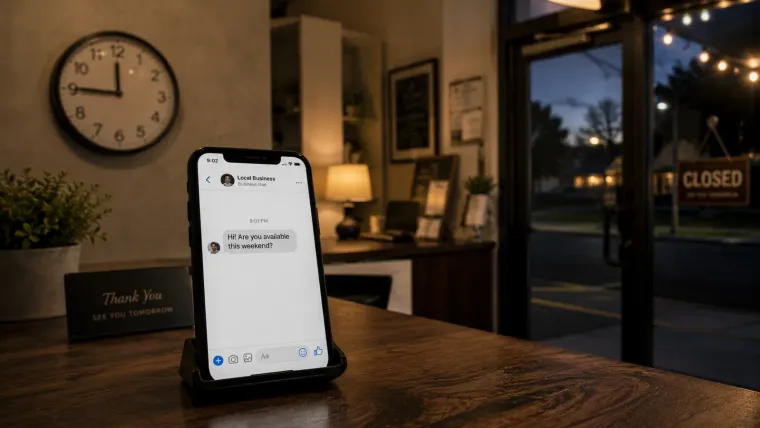
Why Your Business Loses Facebook Leads After 6 PM
Your best leads arrive when you're closed. Here's why the after-hours gap quietly costs local businesses the most — and the fix that answers in five seconds.