

How to Reply to Google Reviews (With Examples), and When to Let AI Draft Them
By Robert Cushman
You look up your business on Google Maps and there it is: a one-star review from three weeks ago, with no reply.
You didn’t see it. Nobody on your team saw it. But everyone who searched for your business since then did.
Replying to reviews is one of those jobs every owner knows matters and almost nobody does on time. Not out of laziness. You’re running the business. This guide gives you copy-ready replies, the rules worth following, and the things you should never write, so a reply takes two minutes instead of half an afternoon.
Why replying matters
A review isn’t a conversation between you and one customer. It’s a conversation between you and one customer in front of everyone deciding whether to walk in.
The person who left the review already had the experience. The real reader of your reply is the next customer, the one comparing your salon with the one down the street, or your dental office with three others in the same plaza. A calm, kind reply to a complaint says more about your business than twenty unanswered five-star reviews.
Google says it plainly in its help center: replying to reviews shows customers you value their feedback. Google recommends replying. I won’t promise you that replying moves you up the map, because nobody outside Google can honestly promise that. What I can tell you is that a profile where the owner answers looks cared for, and one where nobody answers looks abandoned.
Rules before you reply
Fast, but not angry. Aim for a day or two. A negative review answered a week later looks careless; one answered ten minutes later, while you’re fuming, looks worse. If it stung, wait an hour.
Use the person’s name. “Thanks, Sarah” reads differently from “Dear valued customer.” Google’s own review tips suggest addressing the reviewer by name and signing off with your name or initials.
No copy and paste. If your last ten replies all say “Thanks for your business!”, readers stop believing a person writes them. Mention something specific: the haircut, the cleaning, the dress, the brisket.
Short. Three or four lines. When a reply runs long, nobody gets to the point.
Never reveal customer details. Not their phone number, what they bought, when they came in, or what treatment they had. For clinics and medical or dental offices this is even more serious: don’t even confirm the person is your patient. Write about how you work, not about their case. Health details in a public reply are a trust problem, and in the US they can be a HIPAA problem too.
Copy-ready replies
These are templates to adapt, not to paste as-is. Change the details and write the way your business talks.
5-star review
Hair salon:
Thank you, Sarah! So glad you love the balayage. Megan put a lot of care into getting that tone right, so I’ll pass your note along. See you for the touch-up. — Lisa
Restaurant:
Thanks so much, James. We’re thrilled the brisket was the highlight of your Sunday. The pitmaster starts it at 4 a.m., so that means a lot. Come back soon! — The team at Hickory House
3-star review
Boutique:
Thanks for taking the time to write, Emily. Glad you liked the new collection, and you’re right that we were short-staffed at the register on Saturday. We’re adding help that day. Hope you’ll give us another try. — Rachel, Willow Boutique
Dental office:
Thank you for the feedback, Mark. We know waiting in the lobby is frustrating, even when the visit itself goes well. We’re adjusting our schedule so appointments start on time. If you’d like to talk it through, call us at (555) 010-0000. — Dr. Patel
1-star review (fair)
When the complaint is right, the best reply owns it, apologizes without excuses, and takes the conversation offline.
Restaurant:
Anna, you’re absolutely right, and we’re sorry. An hour wait for your food isn’t what we want for anyone. The kitchen fell behind that night and we’ve talked it through with the team. We’d like to make it right; send us a message and we’ll take care of it. — Chris, manager
Hair salon:
We’re so sorry the color didn’t come out the way you hoped, Jessica. That’s not the result we want for any client. We’d love to fix it at no charge; message us and we’ll book you with our colorist. — Lisa
Notice that neither one offers anything in exchange for changing or removing the review. Fixing the problem is fine. Making the fix conditional on the review is not.
1-star review (unfair or fake)
The temptation here is to defend yourself hard. Don’t. Reply calmly, stick to facts, accuse nobody, and then report it (steps below).
Dental office:
Hello. We can’t find a visit in our records that matches what you describe, but we take every comment seriously. If you were seen here, please call us at (555) 010-0000 so we can look into it directly. — Bright Smile Dental
Boutique:
Hi Kevin, we’re sorry about your experience. Our return policy is 15 days with a receipt, and it’s posted in the store and on our profile. If there was a mix-up with your purchase, we’re happy to look into it; send us a message. — Willow Boutique
Look at what the dental reply doesn’t say. It doesn’t say “you are not our patient,” and it gives no details about anyone. It just says the visit can’t be found and opens a door.
Rating with no text
Lots of people leave stars and nothing else. One line is enough, as long as it isn’t the same line every time.
Five stars, no text (restaurant):
Thanks for the five stars! We’re so glad you came in. See you next time. — Hickory House
One or two stars, no text (salon):
We’re sorry your visit wasn’t what you expected. We’d really like to know what happened so we can do better; if you can, message or call us. — Lisa

What you should never write
- “You’re lying,” or any accusation. Even if it’s true, readers see an owner picking a fight.
- The customer’s personal details. Phone, address, what they bought, what treatment they had, when they came in. Not even to “set the record straight.”
- “That’s not our fault” followed by a list of excuses. Explain once, without over-defending.
- Offers in exchange for removing or changing the review. That breaks Google’s policies.
- Sarcasm or “lol.” In writing, it doesn’t read as a joke.
- Promotions inside a reply to a complaint. “Sorry about that! Also, half-price wings on Tuesdays” reads like you never read the complaint.
How to report a fake review
First, an honest caveat: you can’t remove a review because you don’t like it. Google only takes down reviews that break its content policies: spam, offensive language, reviews from someone who was never a customer, from a competitor, or from someone with a conflict of interest.
If the review falls into one of those, these are the steps Google currently documents on its Report inappropriate reviews page:
- Go to your Business Profile (search for it on Google or Maps while signed in with the account that manages it).
- Select Read reviews.
- Next to the review, select Report.
- Choose the reason that fits best (for example, spam).
- Select Send report.
To track it, Google has a Reviews Management Tool, linked from that same help page. It shows whether a report is decision pending, was reviewed with no policy violation, or was escalated. If it’s rejected, you get one appeal per review, so make it count with clear reasons.
While Google decides, reply to the review calmly, like the examples above. A fake review with a composed reply under it tells readers almost everything they need to know.
How to ask for more reviews
Recent reviews matter to people comparing you with the competition. Asking for them is allowed. How some businesses ask is not.
What works:
- A QR code at the counter, on the table, or on the receipt. Google lets you create a short link and QR code from your Business Profile that takes customers straight to the review form.
- A follow-up message by Messenger or text to customers who already message you there. Something like: “Thanks for coming in today, Sarah! If you have a minute, a Google review really helps us: [link].” Short, after the visit, and only to people who already talk to you on that channel.
- Asking in person. At checkout, when the customer says “I love it,” is the best moment there is.
What breaks Google’s policies:
- Offering discounts, gifts, payment or free services in exchange for a review.
- Asking only happy customers for reviews and skipping everyone else.
- Having employees or family review your business, or giving your staff a review quota.
Google can remove reviews collected that way, and all that effort is gone. It isn’t worth it.
Let AI draft, and you approve
The replies above are good. Knowing what to write isn’t the problem. Finding the time, every week, between customers is.
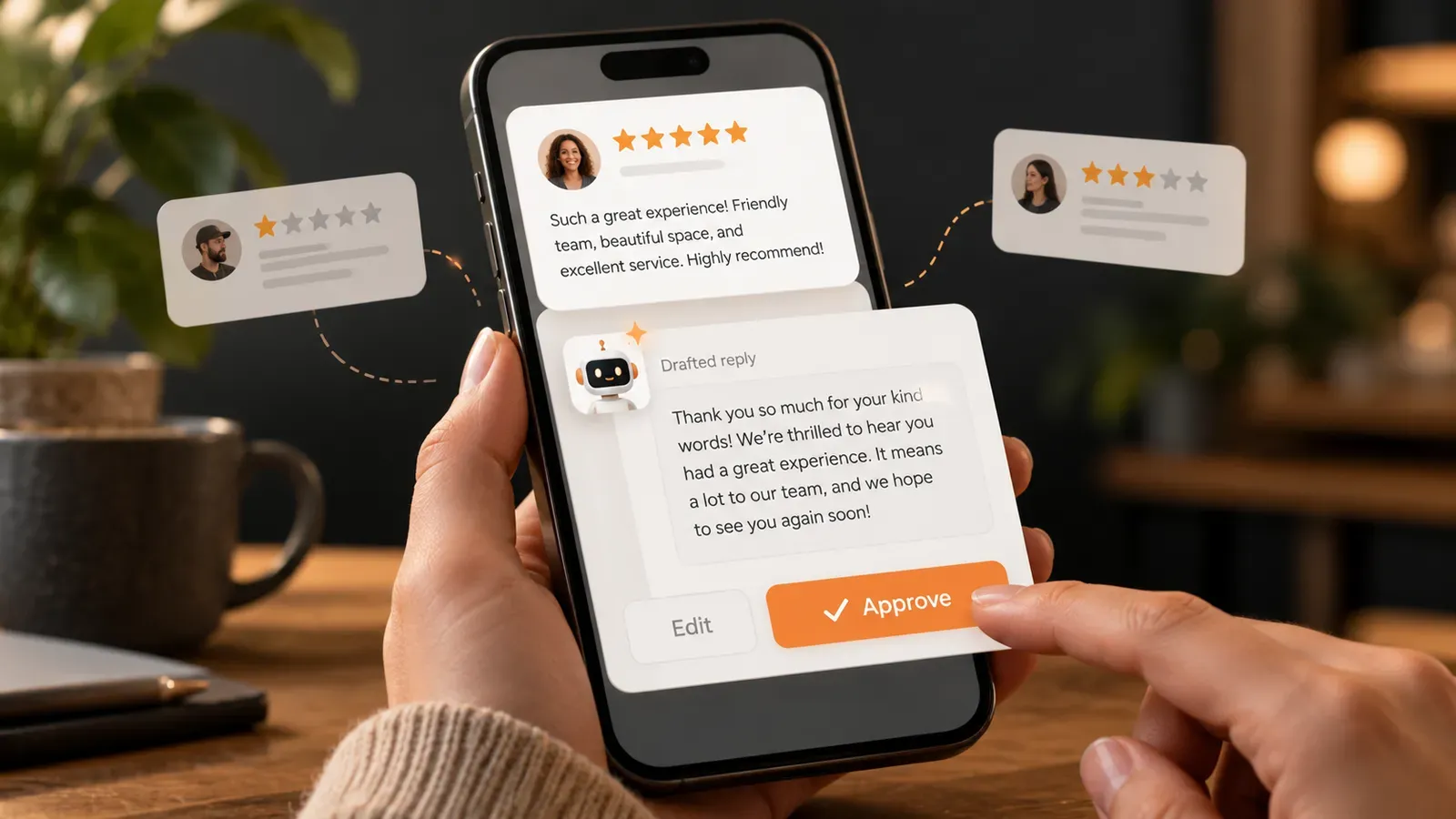
This is where AI genuinely helps, on one condition: you get the final say. The reply goes out under your business’s name. AI can write a warm draft with the right details, but it doesn’t know that this customer has been coming to you for eight years, or that you already fixed Saturday’s complaint over the phone.
Here’s how it works at CushLabs, on the Basic plan:
- We read your reviews straight from Google, so a new one shows up within hours, not days.
- A reply is drafted in your business’s tone, matched to the rating and to what the customer said.
- You approve it. If you don’t approve it, it doesn’t post. No reply goes out without your OK.
- Once you approve, it posts to Google by itself. No logging in to copy and paste.
Today we handle Google reviews. Facebook recommendations, Yelp and TripAdvisor we don’t manage.
The same plan includes an AI assistant on your Facebook Messenger that answers customers at any hour and sends you a WhatsApp alert when someone is ready to buy. Basic is $129 USD a month, with a 1-week free trial that starts the day your assistant goes live. The full breakdown is on the pricing page, and if you want to see an assistant in action, there are live demos.
If your messages tend to arrive after closing time, this one is worth a read too: why Facebook leads that come in after 6 p.m. go cold.
Prefer to talk it through first? Book a free consultation. No pressure, and you’ll leave with a clear next step even if we never work together.
Frequently asked questions
Do I have to reply to every Google review?
You don’t have to, but Google recommends replying because it shows customers their feedback matters. If you can’t get to all of them, start with the negative ones and the ones that ask a question, then the positive reviews with text.
Can I delete a negative review?
No. Only the person who wrote it can delete it. What you can do is reply calmly and, if the review breaks Google’s policies (spam, offensive language, someone who was never a customer, a conflict of interest), report it from your Business Profile so Google reviews it.
How long does Google take to review a reported review?
Google doesn’t commit to a timeline. You can check the status in its Reviews Management Tool: decision pending, no policy violation, or escalated. If the report is rejected, you get one appeal.
Can I offer a discount in exchange for a review?
No. Google’s policies prohibit offering payment, discounts, or free goods or services in exchange for a review, and they also prohibit asking only happy customers for reviews. Ask everyone, and offer nothing in return.
Can I let AI reply to my reviews?
You can let AI write the draft, which saves you from the blank page. But the reply goes out under your business’s name, so someone who knows the business should read and approve it before it posts. That is how CushLabs works: you approve every reply.
Keep reading

What WhatsApp Actually Costs a Small Business in Mexico
Meta charges your business per message on WhatsApp, and on 1 October 2026 it starts charging for a category that used to be free. Here is how the pricing really works, and why an AI chat inbox on WhatsApp is a worse idea than it sounds.

Your Chapalita Boutique Doesn't Stop. Your Answers Shouldn't Either
You're with a customer and three messages come in. You reply when you can, and by then they've gone cold. Here's what the fix looks like for a small shop in Chapalita.

Santa Tere: When the Whole Business Lives in the Owner's Head
Some shops in Santa Teresita have been trading for three generations. The problem isn't a shortage of customers — it's that every answer lives with one person, and she can't be at the counter and on her phone at the same time.